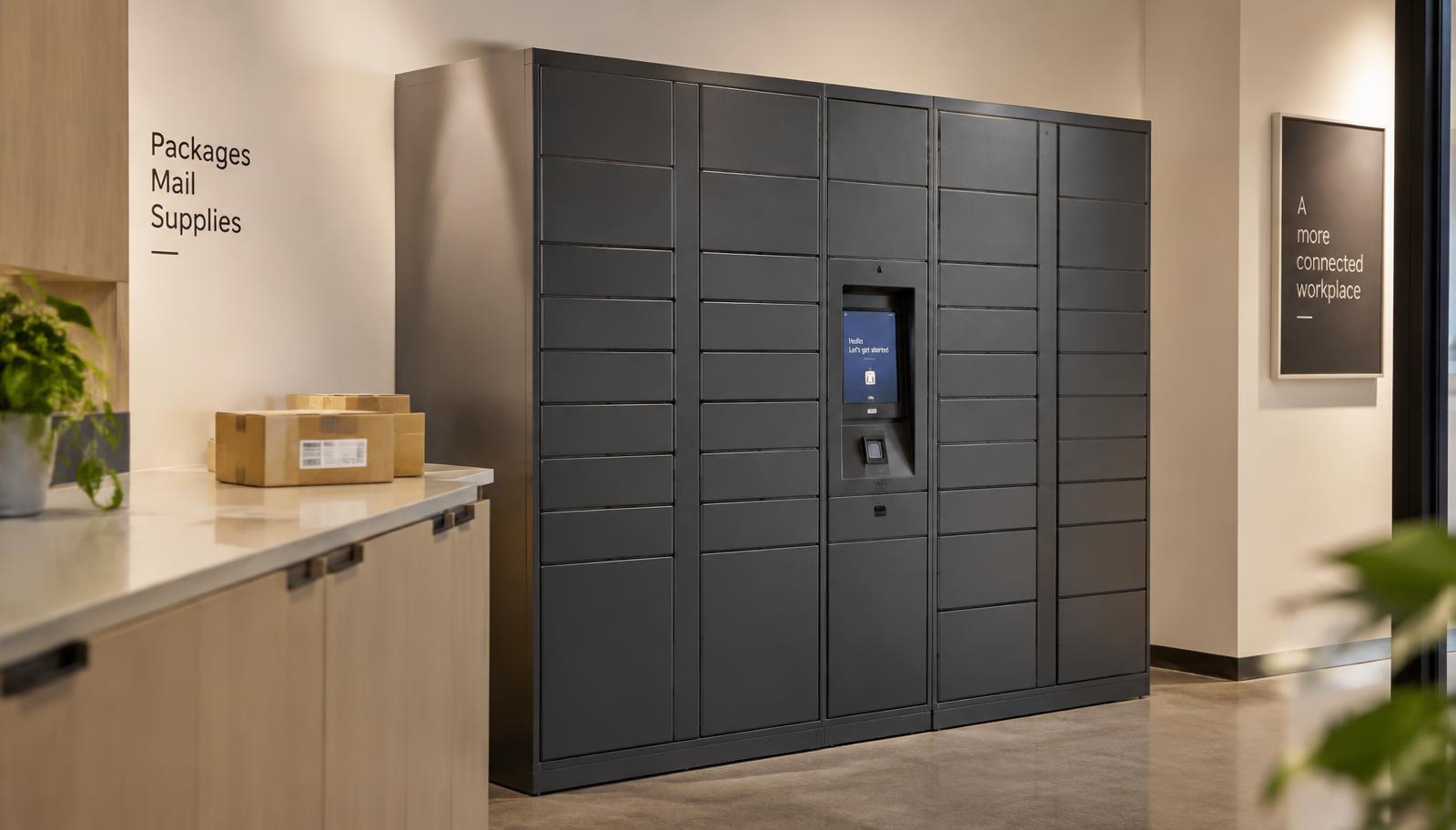
Parcel lockers for offices are usually pitched as the end of the mailroom queue. Deliveries go in a compartment, the recipient gets a code, the front desk stops being a pickup counter. For small standard parcels in a single building, that is largely true and it is a real improvement.
What lockers don't solve is the part of the process that happens before the compartment door closes, and everything that never fits inside one. This is a practical look at where a locker bank earns its floor space, where it quietly hands work back to your team, and how the two approaches fit together.
What a parcel locker actually does
A locker bank is a set of lockable compartments in a range of sizes, usually with a screen or reader at the center. Someone (a carrier, or more often a mailroom or facilities staff member) puts a parcel into a free compartment and assigns it to a recipient. The recipient gets a code or uses a badge, opens the door, and takes the box. The locker records which compartment opened and when.
The value is narrow and genuine: pickup becomes self-service and 24/7. Nobody has to staff a counter at 7pm, the recipient doesn't have to catch the mailroom during its hours, and the shelf behind the desk stops filling up with boxes waiting for people who are working from home that day.
Where lockers struggle in an office
Most of the friction is physical. Compartments are a fixed size and a fixed number, and inbound office volume is neither.
- Oversized and irregular items. Monitors, chairs, trade-show crates, marketing kits, pallets. These are a meaningful share of office inbound and none of them go in a locker.
- Capacity at peak. A locker bank sized to average volume overflows on a Monday or after a holiday, and overflow means the shelf and the paper log are back.
- Uncollected parcels. Every box left in a compartment for three days is a compartment the next delivery can't use.
- Mail, cold chain, and signature-required deliveries. Envelopes, legal service, lab samples, and anything needing a named signature still need a person.
- Cost and floor space. A locker bank is capital expenditure and a permanent footprint in a lobby or mail area, sized once and hard to change.
There is also a quieter gap. A locker tells you a door opened. It does not always tell you who opened it, and it says nothing at all about the parcels that never went in. If your reason for wanting better parcel handling is a missing shipment and a security conversation, locker logs alone rarely close that story.
Lockers and receiving software are answers to different questions
It helps to separate the two. A locker is storage and self-collection hardware. Receiving software is the record: what arrived, who it belongs to, where it is, who was notified, and who took it. Lockers can be one of several places a parcel is stored.
| Need | Parcel locker | Receiving software |
|---|---|---|
| After-hours pickup | Yes, its core strength | Depends on your storage location |
| Oversized and irregular items | No | Yes, any storage location |
| Mail and envelopes | Limited | Yes |
| Named proof of pickup | Compartment event only | Signature, photo, audit trail |
| Volume and dwell-time reporting | Locker contents only | All inbound, per site |
| Multiple buildings | One bank per location | Yes, isolated queues per site |
| Upfront cost | Hardware and installation | Software, existing shelves |
Put plainly: a locker without a record still leaves you guessing about the boxes that didn't fit. A record without a locker still works, it just means pickup happens during staffed hours or at a designated location.
How to decide
Three questions usually settle it. First, what is your size mix? Count a normal week. If a third of inbound is too large for a compartment, lockers are an addition, not a replacement. Second, when do people collect? If most pickups already happen during business hours, the after-hours benefit is smaller than it sounds. Third, what problem are you actually solving? Queue at the desk points toward lockers. Missing parcels, no audit trail, or "nobody told me it arrived" points toward the record.
Before you buy lockers
- Size mix: what share of a normal week is too large for a compartment?
- Peak capacity: bank sized to busiest day, not average, plus dwell for uncollected boxes
- Pickup hours: how much of the pain is after-hours vs desk queue in daylight?
- Proof need: do Security or Finance need a named handoff, not just a door-open event?
- Overflow path: where do oversized, mail, cold chain, and signature-required items go on the same record?
If you're still working out which system should hold that record, our guide on how to choose a mailroom parcel tracking system covers the intake, notification, and proof tests in more detail.
Where Receivly fits
Receivly is the record, not the hardware. Staff scan a parcel on arrival, it matches to a recipient, the recipient is notified automatically, and pickup closes with a signature or pickup code and an audit trail. Storage locations are yours to define (a shelf, a room, a cage, or a locker compartment), so a locker bank can sit inside the same process rather than beside it.
That means oversized crates, mail, and signature-required items stay on the same record as everything else, and facilities reporting covers all inbound rather than just what fit in a compartment. Digital Mailroom, for envelope digitization and recipient mail actions, and Visitor Management are sold on their own or with any parcel plan. Receivly is not a warehouse system or a carrier dashboard. For more on the record side of the process, see mailroom management software.
Access is gated on purpose. If you're weighing lockers against a receiving process, book a demo and we'll walk your actual inbound mix with you, then send a private 30-day trial link when you're ready. For plan shape in plain language, see pricing, or read more about mailroom management software.
FAQ
What is a parcel locker?
A bank of lockable compartments where a parcel is placed for self-collection. The recipient gets a code or badge scan and opens the compartment themselves, so no staff member has to be present at pickup.
Do parcel lockers replace a mailroom?
Rarely. Lockers handle small and medium standard parcels well. Oversized items, pallets, cold shipments, signature-required deliveries, and mail still need a staffed receive point and a storage location.
Do lockers give you proof of pickup?
A locker records which compartment opened and when. That is useful, but it is not the same as a named handoff with a signature, and it only covers the parcels that fit in the locker.
How many locker compartments does an office need?
Size to peak, not average. Measure daily inbound volume on your busiest day, then account for parcels sitting uncollected for a day or two, since a full locker bank falls back to the shelf.